

This season we designed and developed three custom digital activations at fall trade shows. Their products are extraordinarily sophisticated, their audiences remarkably diverse, and the challenge—counterintuitively—isn’t the technology. It’s the content. Having worked in marketing and communications for the aerospace, military, and defense industries amongst others, I want to share some of the similarities and nuances shared with other different industry sectors.
Most people assume that building these interactive applications represents the most demanding work. In reality, the genuine complexity emerges long before any code gets written. For every hour we spend developing the technology, we invest multiple hours in content strategy, information architecture, and messaging hierarchy. We determine what to communicate, to whom, and in what sequence. This upstream work constitutes the lion’s share of the project.
The Content Challenge
Each of the three defense clients represents billions of dollars in research, manufacturing, and operational capability. Naturally, every stakeholder wants everything included: comprehensive technical specifications, detailed architecture diagrams, performance metrics, regulatory certifications, customer case studies, and procurement timelines. But a trade show floor operates under fundamentally different rules than a technical manual or a classified briefing.
We collaborate extensively with subject matter experts, compliance teams, and communications departments to identify what genuinely matters in this high-profile environment. We construct detailed content frameworks that track messaging at every depth level, ensuring that simplified versions for general audiences don’t contradict the comprehensive technical versions reserved for specialists. Compliance teams carefully flag what can be shown publicly and what requires restricted access or special handling.
This intensive vetting process might seem like bureaucratic overhead, but it’s actually the foundation upon which trustworthiness—and ultimately credibility—rests. I come to the table as the Digital SME, they come to the table as industry SME’s. This is how it works across most industry verticals.
Making Complexity Accessible
The central tension in designing for technical audiences in public settings is this: simplify the message enough that a busy visitor can grasp the essential value proposition in five minutes, yet maintain sufficient technical accuracy and depth that engineers and procurement specialists find the work credible rather than condescending.
Progressive disclosure emerges as an elegant solution to this paradox. The initial interface presents a clear value proposition and an engaging overview. A casual visitor understands what the system does and why it matters without feeling overwhelmed. But the application enables deeper exploration. Visitors can navigate toward increasingly technical material—capability matrices, system architecture diagrams, performance specifications, and integration details. Engineers can spend fifteen minutes drilling into the technical depths. Procurement officers can navigate to ROI calculations and total cost of ownership analyses. Military leaders can explore deployment scenarios and strategic outcomes.
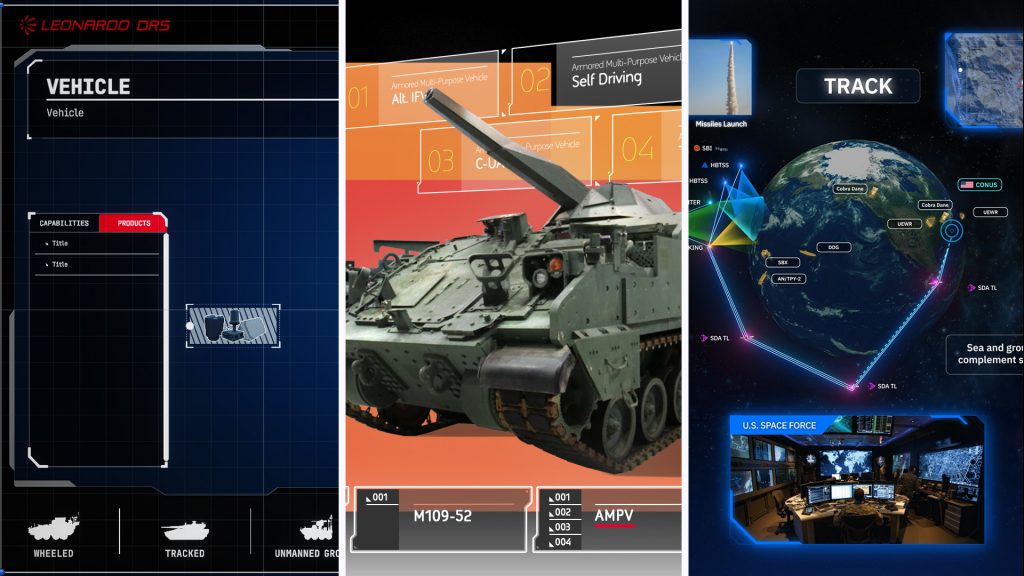
Figure 1.0 | Iterating on a UI design kit for Leonardo DRS, UX/UI style frames for another client, and complex storytelling for another
The real challenge isn’t building these layers from a technical standpoint—that’s straightforward interaction design. The challenge is determining what belongs at each level without compromising accuracy. We ensure that oversimplification doesn’t inadvertently create inaccuracy, and we craft transitions between layers that feel intuitive rather than disjointed. Every specification and comparison must withstand scrutiny from people who genuinely understand the domain.
The result justifies the considerable effort involved. Non-technical decision-makers can understand sophisticated programs without feeling patronized. Engineers access the technical depth they require without wading through marketing language. Audiences across the entire competency spectrum remain engaged while credibility remains intact.
Designing for Three Audiences Simultaneously
Engineers, procurement officers, and military leaders approach technology assessment from fundamentally different perspectives, yet they may all visit the same booth and interact with the same application. This is similar in the tech industry where the audiences and stakeholders are diverse.
Engineers prioritize technical merit and integration capability. They want to know whether systems integrate with existing infrastructure, what failure modes and redundancies exist, how modular the architecture is, and whether technical information is complete. They’ll spend considerable time exploring specifications and can identify immediately if critical details are missing or inaccurate.
Procurement officers focus on budget implications and risk mitigation. They’re thinking about costs relative to capabilities, comparisons to competing solutions, implementation timelines, lifecycle expenses, and whether the financial investment aligns with strategic priorities.
Military leaders and senior executives are concerned with strategic outcomes. They ask whether the system supports mission objectives, what the operational impact might be, how it compares to current approaches, and what risks emerge from adoption or non-adoption.
We design three interconnected but distinct user journeys rather than creating three separate applications. An engineer naturally gravitates toward technical specifications and capability matrices. A procurement specialist finds financial models and comparative analyses. An executive discovers strategic narratives and outcome-focused case studies. Yet all three pathways reference and reinforce each other, creating a coherent experience regardless of which entry point a visitor chooses.
This approach demands absolute clarity about content. Clarity at a technical level and at an audience segment POV. We can’t retreat into vague language or interpretive generosity. Every specification must be defensible across multiple expert audiences simultaneously. Every comparison must be objectively accurate. Every claim must survive rigorous scrutiny from people who understand the domain deeply. We run specialized review tracks—technical content goes to subject matter experts, financial content gets reviewed by contracting officers, strategic messaging gets vetted by senior leadership, and compliance teams check everything. This multi-disciplinary approach builds the trustworthiness that actually closes deals.
Connecting to Everything Else
Trade show applications don’t operate in isolation. They represent one carefully orchestrated waypoint in a customer journey that may span months or even years, from initial awareness through final procurement decision. We build these presentation tools with that journey and marketing and communications ecosystem in mind.
These interactive applications function as sophisticated lead-capture and qualification mechanisms. We track which content areas engage different types of visitors. An engineer spending fifteen minutes exploring technical architecture sends distinctly different signals than an executive who quickly reviews strategic capabilities. We flag these engagement patterns and connect them to broader CRM systems, enabling follow-up communications that are genuinely relevant to each visitor’s demonstrated interests.
Content strategy must align seamlessly across the entire marketing ecosystem. The messaging emphasized in the trade show application should appear in post-show email sequences. The narratives presented on the touchscreen should continue into sales conversations. The competitive comparisons highlighted in the booth should show up in sales decks and promotional materials.
We create comprehensive content style guides that ensure consistency across all touchpoints—visual design, tone of voice, terminology, and narrative structure remain coherent from the trade show floor through websites to sales conversations and beyond. This consistency builds confidence. When prospects encounter the same messaging and positioning across multiple channels, it reinforces credibility and reduces cognitive friction during decision-making.
The applications also provide valuable feedback for future marketing strategy. By tracking which content areas generate the most engagement, which use cases resonate most powerfully with visitors, and which questions prospects explore most deeply, we identify patterns that inform the next generation of marketing materials. The trade show apps become research instruments providing real-time insights into what messaging and positioning actually move prospects toward engagement.
The Real Work
These applications succeed because they’re grounded in rigorous content strategy and information architecture, not because of sophisticated technology. The technology itself is competent and largely invisible—it enables the content to shine without calling attention to itself.
The genuine complexity doesn’t reside in building the application. It resides in determining what story to tell, in serving three expert audiences simultaneously without alienating any of them, in maintaining accuracy while simplifying complexity for diverse audiences, and in ensuring that one touchpoint integrates seamlessly into a larger marketing ecosystem. For anyone building interactive experiences in technical, regulated, or highly specialized domains, the fundamental lesson is clear: invest disproportionately in content strategy and information architecture. No amount of sophisticated interface design compensates for unclear thinking about what to communicate or whom you’re trying to reach. The hardest work happens upstream of development.